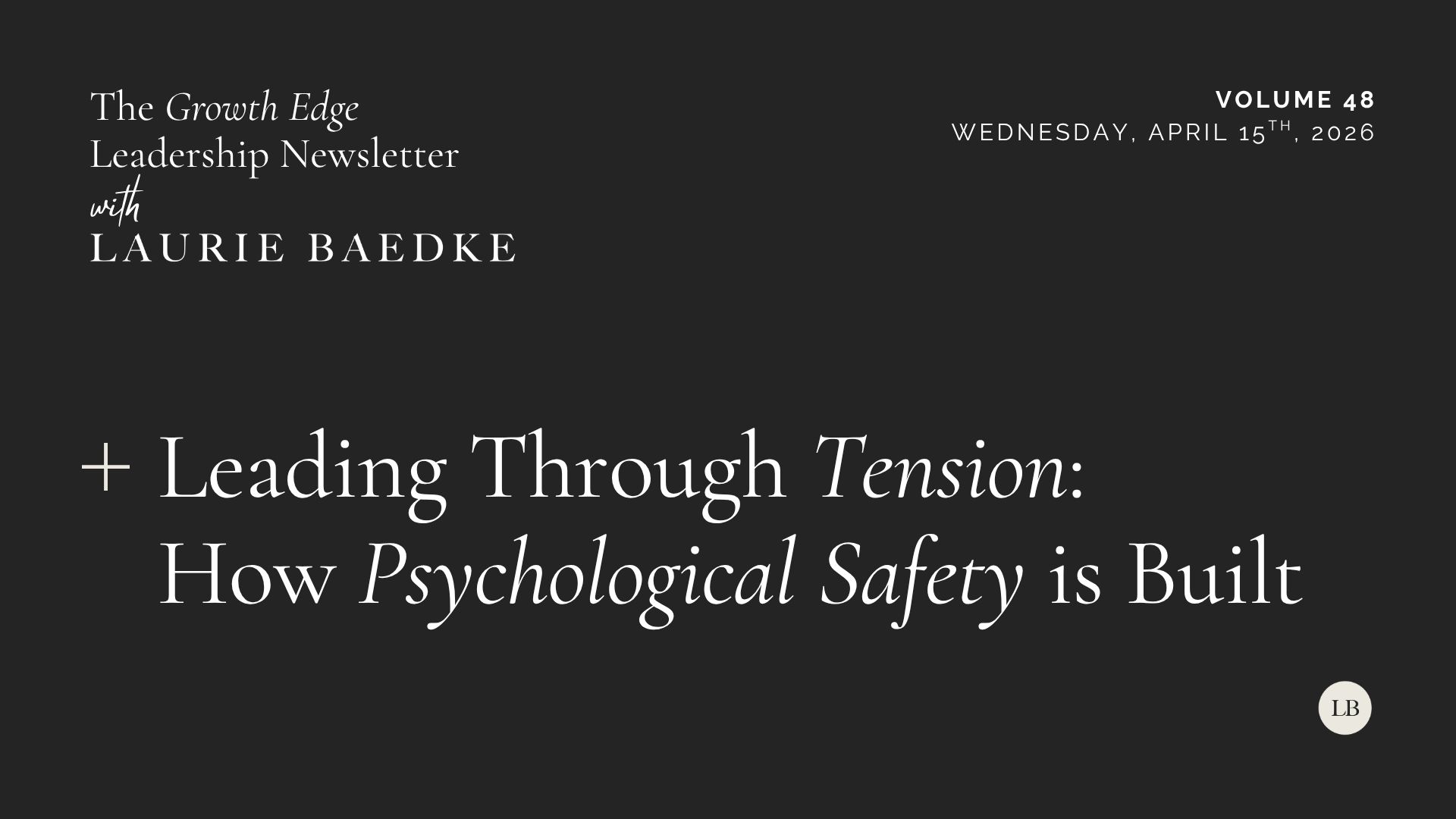
Psychological safety is not built in moments of ease. It is revealed, and reinforced, in moments of tension.
The week before last, I arrived a little early to a rural critical access hospital in the Midwest for a quarterly leadership development session.
As I walked into the room, the group was mid-discussion, engaged in a spirited conversation about redesigning a longstanding hospital-wide process.
There was tension.
Some leaders felt strongly about preserving elements of the current approach.
Others voiced frustration about having been excluded from prior decisions.
Assumptions were being challenged.
Perspectives didn’t align.
It was, in many ways, exactly the kind of conversation organizations need to have.
But also the kind many avoid.
Because tension, if not well-managed, can quickly become personal, or shut down altogether.
This Is Where Psychological Safety Lives
Psychological safety is not tested when everyone agrees.
It is tested when they don’t.
It is not built through scripted exercises.
It is built in real-time, in conversations like this, where uncertainty, disagreement, and competing priorities intersect.
The question is not whether tension will exist.
The question is whether leaders can hold that tension productively.
What Gets In the Way
In many organizations, two common patterns emerge:
One is artificial harmony, where disagreement is suppressed in the name of collegiality.
The other is unproductive conflict, where conversations become positional, defensive, and unconstructive.
Neither creates psychological safety.
True psychological safety sits between these extremes. It allows for candor without consequence and accountability without threat.
What the Research Reinforces
Research from Amy Edmondson highlights that psychologically safe teams are not less demanding, they are actually more willing to engage in rigorous dialogue.
Similarly, studies published through Harvard Business Review emphasize that high-performing teams combine psychological safety with high standards, a balance sometimes referred to as “high support, high challenge.”
This is particularly critical in healthcare, where decisions are complex, time-sensitive, and consequential.
The goal is not to eliminate tension.
The goal is to make tension useful.
How Leaders Build Psychological Safety, Especially in Tense Moments
It begins with how leaders show up in the moment.
When disagreement surfaces, leaders have a choice:
→ To shut it down…
→ To take sides…
→ Or to facilitate it.
The most effective leaders do the latter.
They slow the conversation just enough to create clarity.
They separate people from positions.
They anchor the discussion in shared purpose, like mission, patient care, quality outcomes.
They ask questions that expand thinking:
❓ “What perspective might we be missing?”
❓ “Help me understand what’s driving that concern.”
❓ “Where do we actually agree?”
They model intellectual humility, acknowledging what they don’t know, and remaining open to being influenced.
And critically, they reinforce that speaking up is not just allowed, it is expected.
Practical Application in Healthcare Settings
In high-stakes environments, this often looks like:
💡 Creating structured opportunities for input before decisions are finalized
💡 Explicitly inviting dissenting viewpoints in meetings
💡 Responding to concerns with curiosity rather than defensiveness
💡 Closing the loop, ensuring people see how their input influenced outcomes
And perhaps most importantly:
💡 Addressing behaviors that undermine safety, dismissiveness, interruptions, or punitive responses, swiftly and directly.
Because psychological safety is fragile.
It is built slowly and eroded quickly.
Returning to the Room
In that rural hospital, what mattered most was not whether the group immediately aligned on a new process.
What mattered was whether they could stay in the conversation that was difficult in the moment.
✅ Whether individuals felt heard, even when not agreed with.
✅ Whether assumptions could be surfaced and examined.
✅ Whether the group could move toward a better solution, not just a faster one.
That is the work.
Closing Reflection
Consider your last tense leadership conversation.
Did it move the work forward, or did it narrow it?
Did people lean in, or pull back?
And perhaps most importantly:
What did your response signal about what is safe in your culture?
Psychological safety is not built through intention alone. It is built through behavior, consistently, visibly, and often in the moments that matter most.
I'm rooting for you!