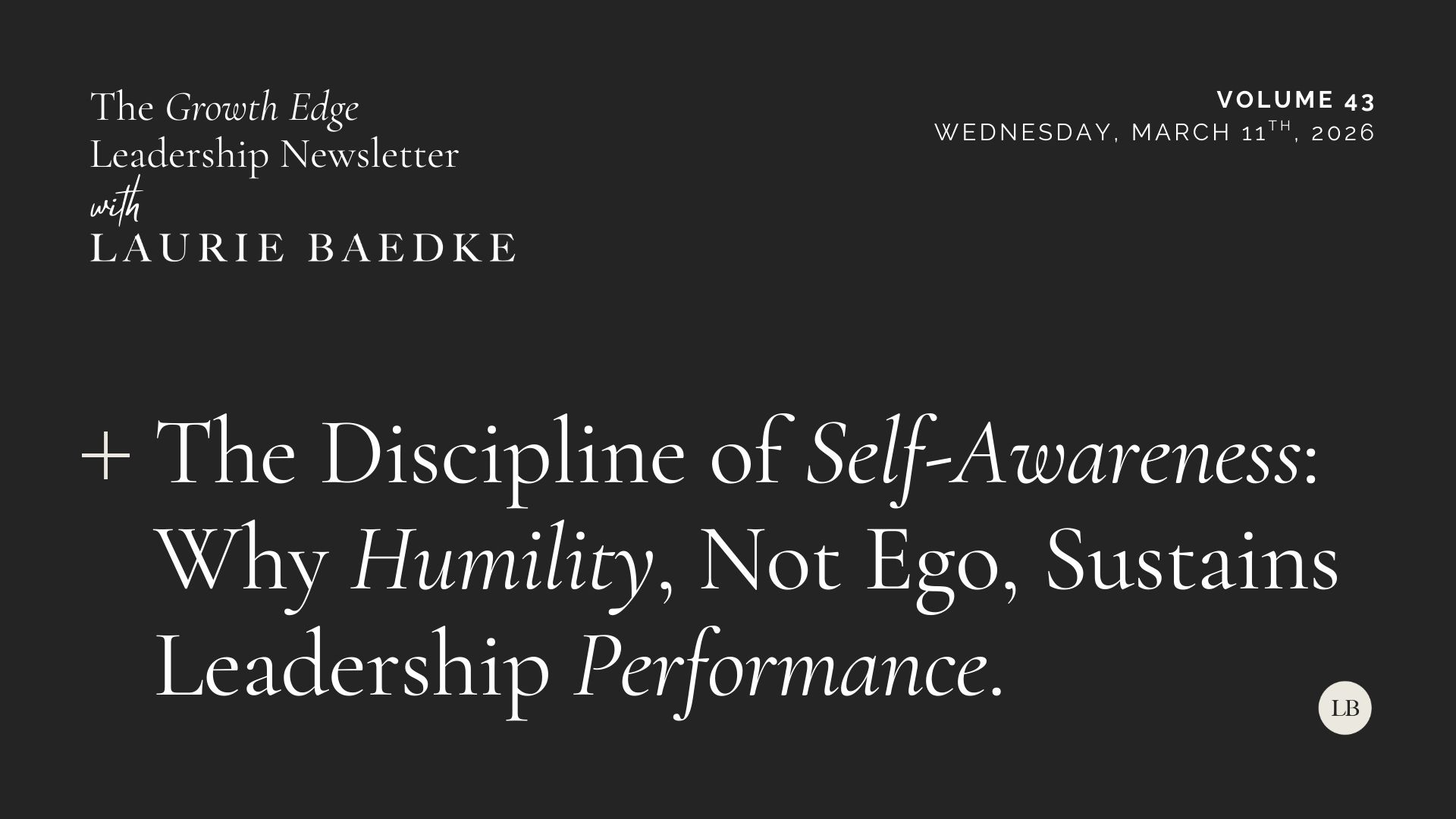
You don’t have to be loud to have an ego.
Even the most thoughtful, analytical, and measured leaders can quietly protect their assumptions, defend their decisions, or resist feedback.
Ego isn’t about personality.
It’s about posture.
And humility is the discipline that keeps it in check.
In leadership, ego often gets rewarded first.
Humility gets rewarded later, but longer.
There is a difference between being perceived as strong and actually being effective.
And that distinction matters.
The Perception Gap
Research shows that leaders who project confidence and certainty are often perceived as more capable in the early stages of leadership. Narcissistic traits; dominance, charisma, boldness, or drive, can accelerate leader emergence.
But longitudinal research tells a more sobering story.
Over time, teams led by narcissistic leaders demonstrate lower collaboration, reduced trust, and weaker performance outcomes. By contrast, leaders characterized by humility; those who accurately assess themselves, admit limitations, and elevate others, foster stronger learning behavior, higher engagement, and better results.
Ego creates visibility.
Humility creates sustainability.
And sustainable performance is the real measure of leadership.
What Leadership Humility Actually Is
Humility is not self-doubt.
It is not passivity.
It is not shrinking.
Humility is accurate self-assessment paired with openness to growth.
Humble leaders:
- Acknowledge mistakes without deflecting blame
- Invite dissent without punishing it
- Recognize their limitations without losing decisiveness
- Share credit generously
They remain confident, but not defensive.
They remain steady, but not brittle.
This is not softness. It is stability.
Why Humility Drives Performance
Humility strengthens three essential drivers of high-performing teams.
1. It Builds Psychological Safety
When a leader says:
“I missed that.”
“I could have handled that better.”
“What am I not seeing?”
They reduce interpersonal risk in the room.
Teams mirror the leader’s posture. If the leader never admits fault, neither will the team. If the leader deflects responsibility, accountability erodes. If the leader appears invulnerable, candor disappears.
Psychological safety is not created by policy.
It is modeled by humility.
Without it, innovation slows. Errors get hidden. Learning stalls.
With it, teams speak up sooner, solve problems faster, and trust more deeply.
2. It Fuels Learning Agility
Ego protects identity.
Humility protects growth.
In complex and fast-moving environments, healthcare especially, certainty expires quickly. Leaders who treat feedback as data rather than threat adapt faster. They recalibrate earlier. They conserve energy that would otherwise be spent defending outdated assumptions.
Humility keeps leaders coachable.
And coachability is a long-game advantage.
3. It Builds Durable Trust
Teams trust leaders who:
- Take responsibility
- Own outcomes
- Avoid blame
- Remain composed under pressure
Humility signals security. And secure leaders create stable cultures.
You cannot demand trust.
You earn it through self-awareness.
The Real Barrier to Humility
If this resonates, but feels risky, that makes sense.
Many high-performing professionals hesitate to admit weaknesses or acknowledge mistakes because they have experienced environments where vulnerability was weaponized.
If you have ever:
- Worked on a toxic team
- Reported an error and been publicly shamed
- Disagreed with a superior and paid for it
- Watched transparency become political leverage
You likely learned a powerful survival skill: armor up.
In dysfunctional systems, weakness becomes currency.
That reluctance is understandable.
But what protected you in an unhealthy culture may limit you in a healthy one.
Humility requires discernment.
It is not reckless transparency.
It is not emotional dumping.
It is not performative vulnerability.
It is calibrated authenticity grounded in regulation.
Vulnerability vs. Instability
There is an important difference.
Vulnerability says:
“I made a mistake. Here’s what I learned.”
Instability says:
“I don’t know what I’m doing and I’m overwhelmed.”
The first builds trust.
The second transfers emotional burden.
Humility is vulnerability anchored in steadiness.
It reassures the room while inviting growth.
A Reflection for You
Consider:
- When was the last time I publicly acknowledged a mistake?
- Do my team members feel safe disagreeing with me?
- Have I unintentionally created a culture where weakness is punished?
- Where might my confidence be crowding out curiosity?
Self-awareness is not a personality trait.
It is a disciplined practice.
Three Small Moves This Week
→ In your next leadership meeting, name one recent misjudgment and the insight it produced.
→ Ask a trusted peer: “What’s one blind spot I may not see?”
→ Publicly credit someone who challenged your thinking.
Small acts of humility compound cultural safety.
The Bottom Line
Narcissistic leaders often rise quickly.
Humble leaders endure.
Ego may create presence, but humility creates performance.
The most effective leaders are not those who appear the strongest.
They are the ones strong enough to remain teachable.
And that is not weakness.
That is leadership.
I’m rooting for you.
CURATED RESOURCES
To Get Ahead, You Need Both Ambition and Humility, HBR IdeaCast podcast, with Dr. Amer Kaissi
The Power of Believing That You Can Improve, TEDxNorrkoping, with Dr. Carol Dweck